
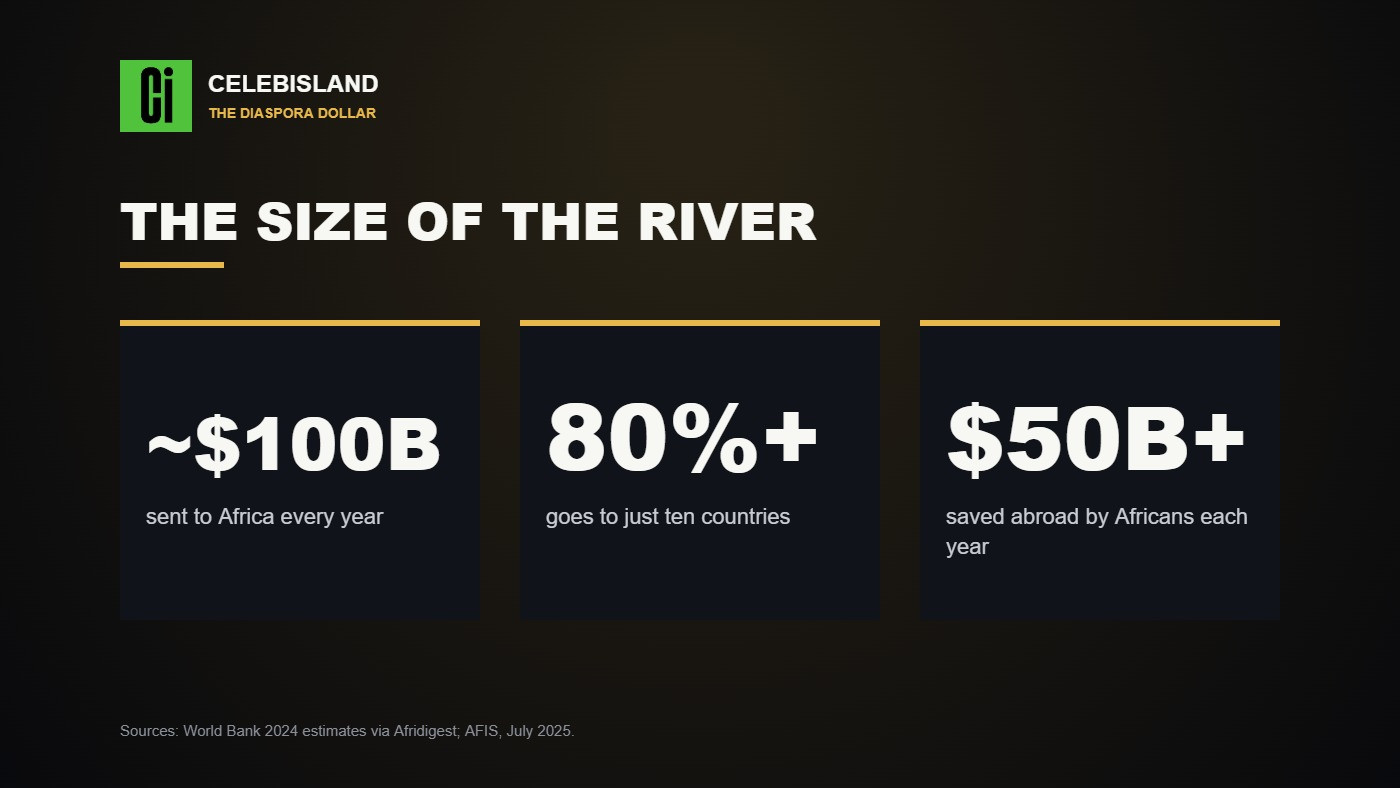
Africa's people abroad send home close to $100 billion a year. It travels person to person: from a salary in Houston or Manchester to a mother in Kumasi, a school fee in Enugu, a roof in Mombasa. Before we argue about who should take a cut of that river, let us look at the river itself.
The numbers behind the river
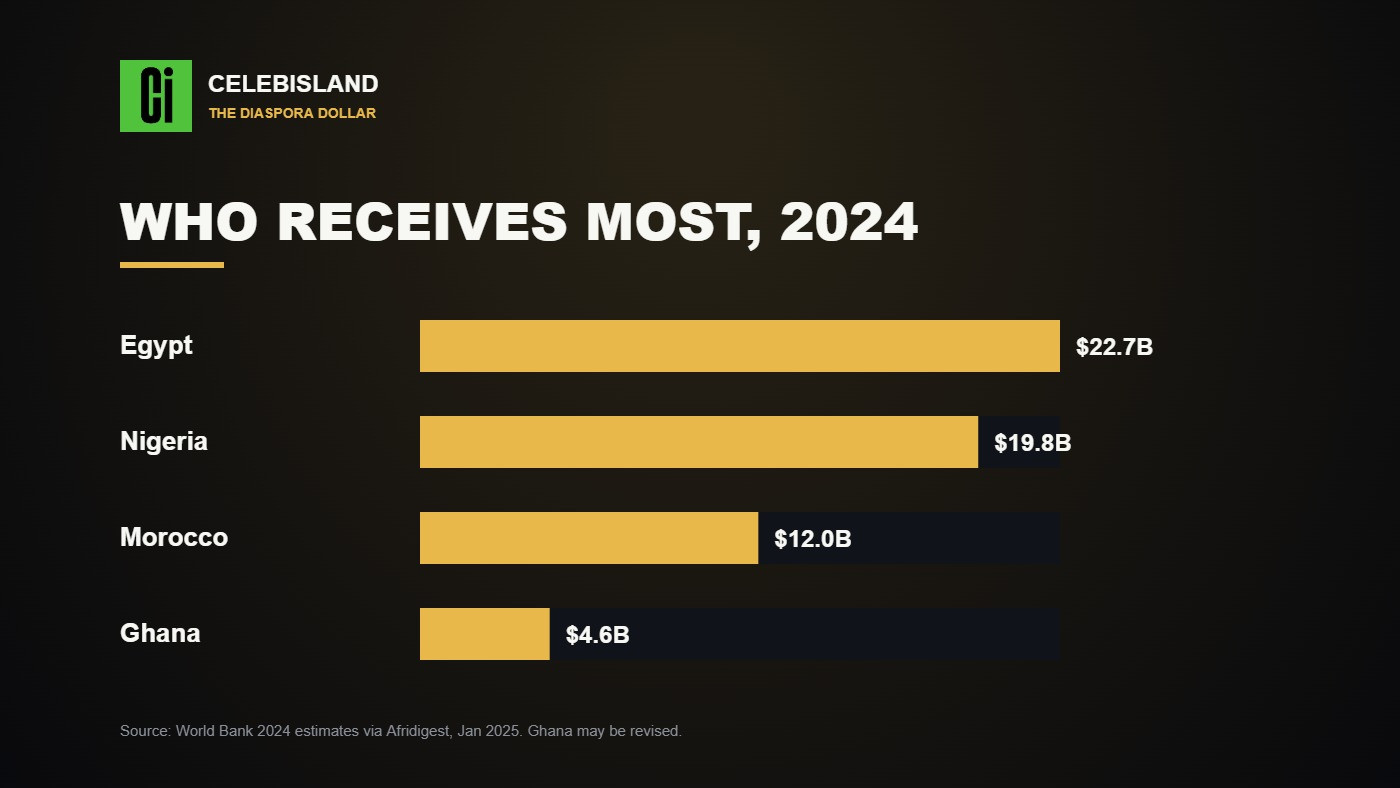
According to World Bank estimates for 2024, Egypt received about $22.7 billion, Nigeria $19.8 billion, Morocco $12 billion and Ghana $4.6 billion, although the Ghana figure may be revised. The top ten recipients take more than 80 percent of everything, and North Africa alone accounts for roughly 42 percent. The flow has grown at about 10 percent a year over the long run.
The toll booth
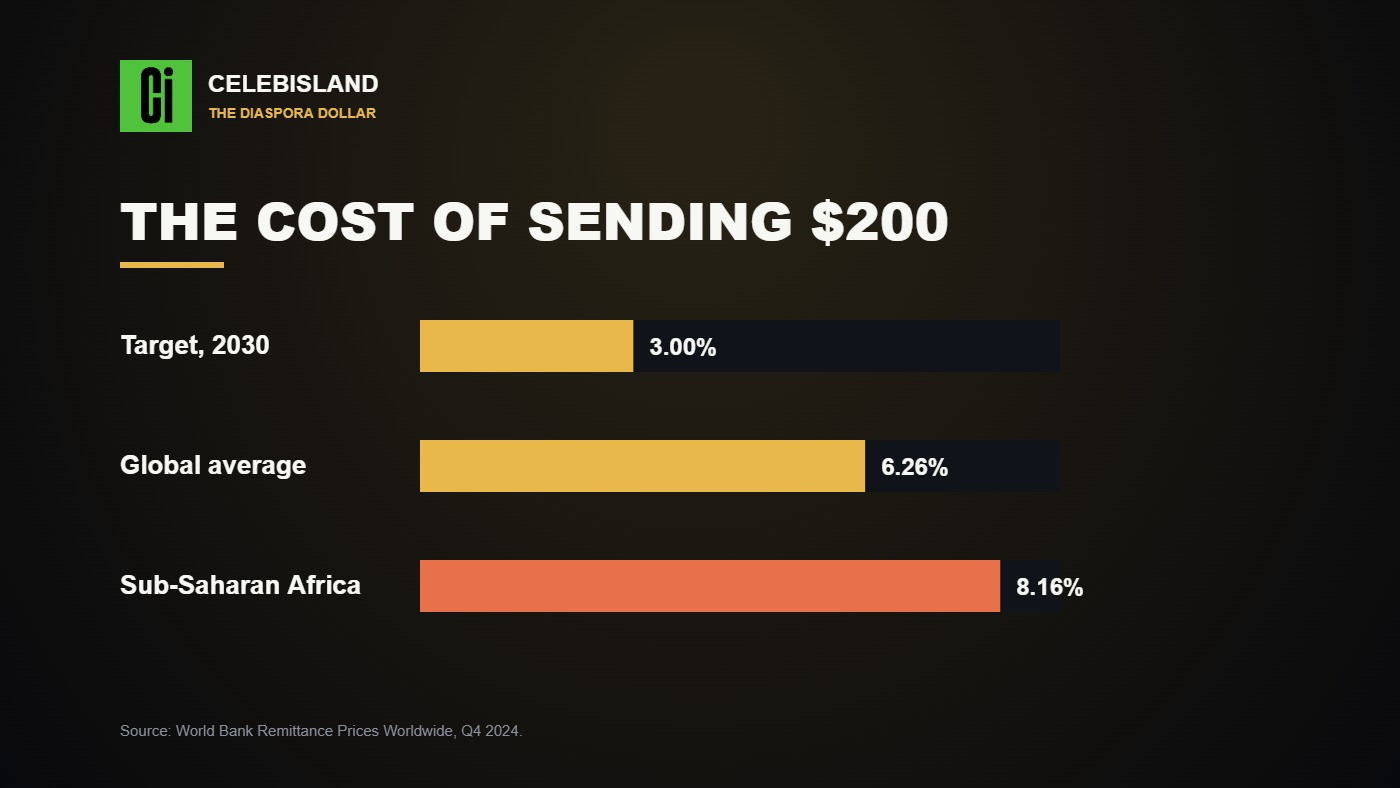
The World Bank's Remittance Prices Worldwide tracker put the average cost of sending $200 to sub-Saharan Africa at 8.16 percent in the last quarter of 2024. The global average was 6.26 percent, and the development target is 3 percent by 2030. If a rate like that applied across the whole $100 billion, fees would run to roughly $8 billion a year. That is a back-of-envelope illustration, not a measured total, because costs differ widely between corridors. The direction is still plain: our families pay more than almost anyone to move their own money.
From remittance to capital
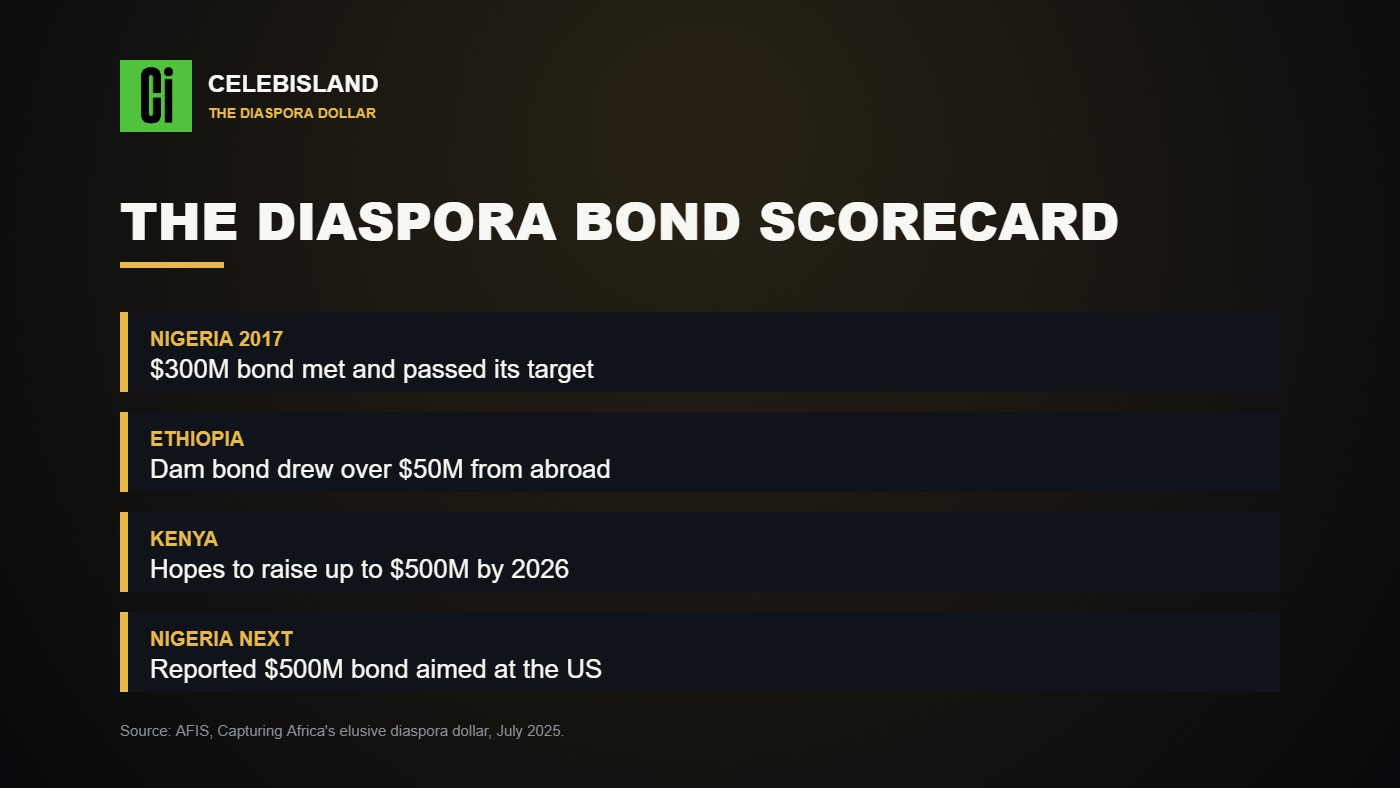
Remittances feed households. Savings build nations. The Africa Financial Summit's programme lead, Oliver Nieburg, wrote in July 2025 that Africans abroad hold more than $50 billion in annual savings, yet diaspora bonds have mostly disappointed. Issues from Ethiopia, Ghana and Kenya have been undersubscribed since 2007. Nigeria's 2017 diaspora bond of $300 million met and passed its target, and Ethiopia's dam bond drew more than $50 million from abroad. Kenya hoped to raise up to $500 million from its diaspora by 2026, and Nigeria is reportedly considering a $500 million bond aimed at Nigerians and their descendants in the United States.
His diagnosis is worth hearing: investors fear single-country risk, and the business case has to be strong, because sentiment alone will not carry a bond.
What this means for Africa
A sovereign continent does not beg for its own people's money. It designs for it. Cut the toll by licensing and backing low-cost corridors and letting fintechs compete, and measure success by how close we get to that 3 percent. Pool the risk through infrastructure bonds backed across borders, so a diaspora investor is not betting on a single ministry. Publish the data, because every government should know who its diaspora is, where they live and what they would fund. Then report the returns honestly, because trust compounds like interest.
What this means for Black America
Many African Americans cannot trace a line to one village, and the market is beginning to notice that the word diaspora is widening. The proposals now on the table speak of descendants and of people with an affinity for Africa, and a bond aimed at the United States is exactly that door opening. Treat it like any investment: read the prospectus, compare the risk, ask who guarantees repayment, and show up as an owner, not as sentiment. This is not charity and it is not a pilgrimage tax. It is a chance to hold a stake in the continent's roads, power and software, on terms that serve both sides of the Atlantic.
The kings and queens test
Before your next transfer or investment, ask three questions. What did it cost? What did it build? Who owns the result? If the answers are "too much", "a month of groceries" and "someone else", the problem is not the family. It is the system, and systems can be redesigned.
Sources: Afridigest, "Diaspora remittances: Africa's $100 billion opportunity" (7 January 2025, citing World Bank 2024 estimates); World Bank, Remittance Prices Worldwide, Issue 52 (December 2024); Africa Financial Summit, "Capturing Africa's elusive diaspora dollar" (28 July 2025). Cost figure for fees across the full flow is an illustration by CelebIsland, not a published statistic. Photography: AI generated illustration.