Between October 1960 and October 1979 Nigeria was led by six men, and the highest office itself changed shape more than once. It began as a parliamentary premiership under a governor general, became a ceremonial presidency with a prime minister beside it, passed to a series of military heads of state, and ended the period as an executive presidency. This is the record, in order, with the dates that matter and the way each tenure ended.
1960 to 1966: Balewa and Azikiwe
Sir Abubakar Tafawa Balewa was born in Bauchi in December 1912 and was already leading the federal government when Nigeria became independent on 1 October 1960. He stayed on as Prime Minister of the independent federation, heading a coalition between the Northern People's Congress and Nnamdi Azikiwe's National Council. He held the office until 15 January 1966, when he was removed and killed in the country's first military coup. His body was found at a roadside outside Lagos days later, and the circumstances of his death have never been fully settled.
The head of state was a separate person. Nnamdi Azikiwe, born in Zungeru on 16 November 1904, became Governor General on 16 November 1960. When Nigeria became a republic on 1 October 1963 he became its first President. The post was largely ceremonial, and his presidency ended on 16 January 1966. He lived until 11 May 1996 and stood for the presidency again in 1979 and 1983.
January 1966: The handover nobody planned
Azikiwe was out of the country in late 1965, and under the constitution the President of the Senate acted in his place. That was Abyssinia Akweke Nwafor Orizu, born in Nnewi on 17 July 1914, a graduate of Ohio State University and Columbia University and the author of the 1944 book Without Bitterness. When the coup of 15 January 1966 left the Prime Minister and two regional premiers dead, it was Orizu who went on the air. He announced the cabinet's decision to transfer power to the armed forces, and the army accepted.
1966: Johnson Aguiyi-Ironsi
Major General Johnson Thomas Umunnakwe Aguiyi-Ironsi was born in Umuahia on 3 March 1924. He was a career soldier who had commanded United Nations peacekeeping forces in the Congo in 1964, and as the senior surviving officer he put down the January mutiny and took charge of the government on 16 January 1966. His decree abolishing the regional structure in favour of a unitary state was read in the North and West as an ethnic power grab and drew fierce opposition. He was killed near Ibadan on 29 July 1966, 194 days into his tenure, during a counter coup led by northern officers.
1966 to 1975: Yakubu Gowon
Yakubu Gowon was born on 19 October 1934 in what is now Plateau State and trained as an officer at Sandhurst. He emerged as the compromise choice after the July 1966 counter coup and became head of state on 1 August 1966, a tenure that ran almost nine years, the longest unbroken spell any Nigerian leader has had. In May 1967 he divided the country into twelve states. Days later the Eastern Region seceded as Biafra and the civil war began. It ran for thirty months and ended in January 1970, and Gowon marked the surrender with the declaration that there was no victor and no vanquished, followed by a programme of reconciliation, reconstruction and rehabilitation. He was removed in a bloodless coup on 29 July 1975 while attending a summit in Uganda. In exile he took a doctorate at the University of Warwick and later taught political science at the University of Jos.
1975 to 1976: Murtala Muhammed
Murtala Ramat Muhammed was born in Kano on 8 November 1938 and became head of state on 29 July 1975. He held the office for a little over six months and moved at speed. He dismissed thousands of public officials, created seven new states on 3 February 1976 to bring the total to nineteen, announced on the same day that the federal capital would move from Lagos to a new territory at Abuja, and set a timetable for a return to civilian rule. On 13 February 1976 he was ambushed and assassinated in Lagos during a failed coup. He was 37.
1976 to 1979: Olusegun Obasanjo
Olusegun Obasanjo, born in March 1937, was Murtala Muhammed's deputy and was appointed by the Supreme Military Council to succeed him. He kept the timetable he had inherited. Elections were held in July and August 1979, and in October he handed power to the winner, making him the first military ruler in Africa to give way to an elected civilian government. At the inauguration he presented the new President with a copy of the new constitution.
1 October 1979: Shehu Shagari
Shehu Usman Aliyu Shagari was born in Shagari, in what is now Sokoto State, on 25 February 1925. He had been a teacher before politics, won a seat in the federal House of Representatives in 1954 and held senior government posts after independence. He took office on 1 October 1979 as President of the Second Republic, narrowly beating Obafemi Awolowo, and won a contested re-election in 1983 against a background of falling oil revenue and corruption allegations. His government was removed by a military coup on 31 December 1983. He was cleared of personal corruption and released in 1986, and died in Abuja on 28 December 2018 at the age of 93.
Nineteen years, six leaders
Read in sequence the pattern is hard to miss. Two of the six were killed in office, three were removed by force, and only one handover in nineteen years was voluntary. The period also produced decisions Nigerians live with every day: the state structure, the move to Abuja, and the shape of the presidency itself.
Tribute pages on CelebIsland
CelebIsland members keep unofficial tribute and fan pages for the figures in this article. None of them is affiliated with, endorsed by, or managed by the people they honour.
- Abubakar Tafawa Balewa Tribute
- Nnamdi Azikiwe Tribute
- Nwafor Orizu Tribute
- Johnson Aguiyi-Ironsi Tribute
- Yakubu Gowon Fans
- Murtala Muhammed Tribute
- Shehu Shagari Tribute
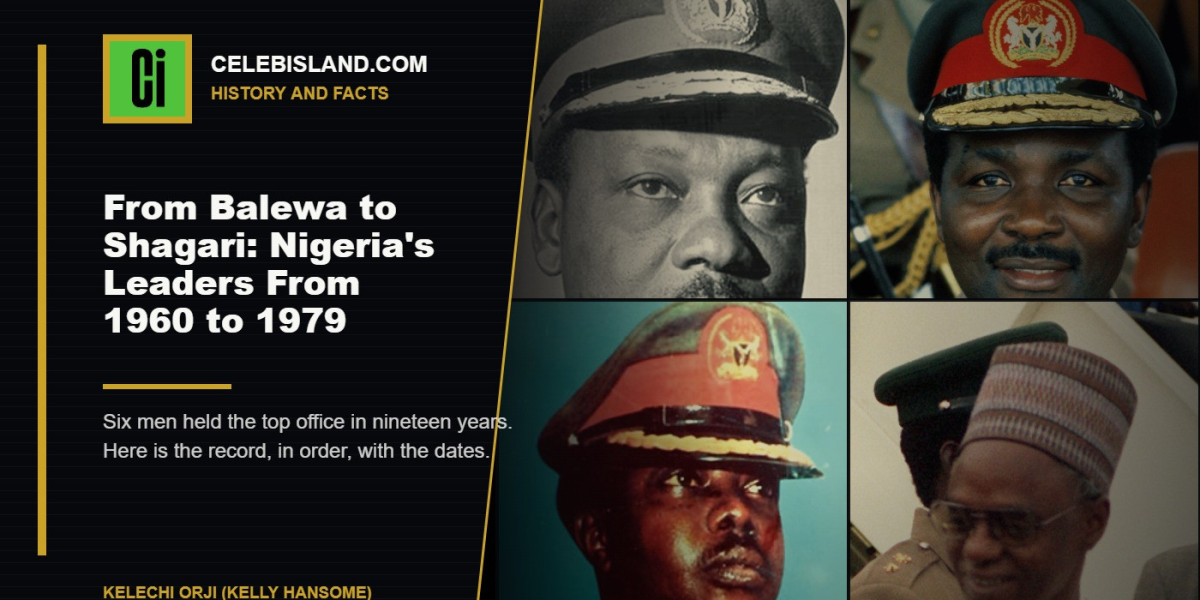
Cover image built from four portraits in the public domain: Major Gen. J.T.U. Aguiyi Ironsi, Gen. Yakubu Gowon GCFR and Gen. Murtala Muhammed, all held by the National Library of Nigeria, and a United States Department of Defense photograph of President Shagari. All four were sourced from Wikimedia Commons.