Go into almost any comment section where Nigerians and Black Americans are talking to each other, and wait. It never takes long.
Somebody says Africans sold their own people. Somebody replies that Black Americans do not know where they are from. Somebody brings up crime statistics. Somebody brings up colonisation. Within forty replies, two groups of Black people who have never met are insulting each other about a history neither of them chose.
Then everybody logs off and pretends it did not happen.
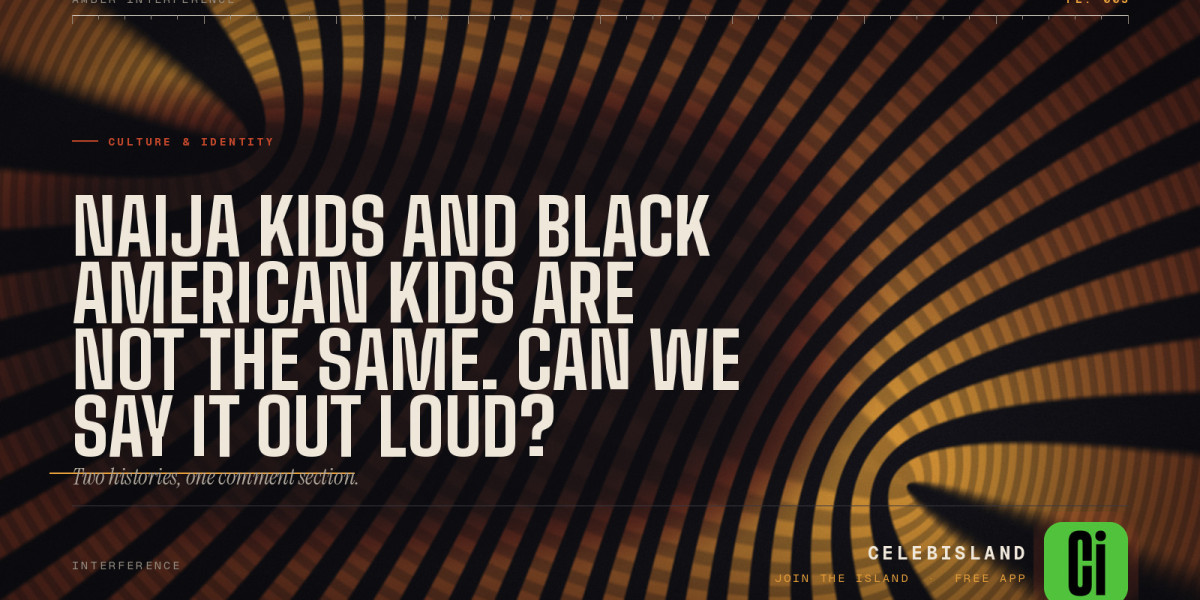
So let us actually talk about it. Naija kids and Black American kids are not the same — and pretending otherwise is part of why the fights keep happening.
Different Wounds, Not Different Worth
Start with the honest part. These are two peoples shaped by two completely different catastrophes.
Black Americans descend from people who were stolen, stripped of language, name, religion and lineage, and then spent centuries in a country that legislated against their existence. The wound is disconnection. Not knowing. Being from a place that will not tell you which place.
Nigerians were colonised in place. We kept our languages, our names, our people, our land — and we lost sovereignty, wealth, and self-determination. The wound is extraction. Knowing exactly who you are and watching somebody else run your house.
These produce entirely different people. One group spent generations fighting to be seen as fully human in a country that was theirs. The other spent generations fighting to run a country that was already theirs. You cannot expect the same instincts from that.
What We Get Wrong About Them
Let me start with my own side, because that is the honest order.
Nigerians love to arrive in America and immediately start diagnosing Black Americans. Why don't they work harder. Why is the family structure like that. We came here with nothing and look at us. It is one of the ugliest habits we have, and we do it constantly.
It ignores something obvious: the Nigerian who lands in Atlanta is not a random Nigerian. He is the one who got a visa. That usually means school fees somebody paid, English somebody taught him, documents somebody helped process. He is a selected sample arriving into a system that Black Americans spent generations forcing open — with marches, with lawsuits, with funerals. The immigrant walks through a door that other people bled to unlock, then turns around and lectures them about effort.
And the cultural debt runs deeper than that. The reason Afrobeats can fill arenas in America is that Black American music built the highway first. Hip-hop and R&B created the audience, the industry infrastructure, the idea that Black music is global business. Our artists drive on a road somebody else paid for. We should say that more often than we do.
What They Sometimes Get Wrong About Us
Now the other direction, and it deserves the same honesty.
The line that Africans sold Black Americans into slavery gets thrown out as a conversation-ender. It is historically shallow. Some African rulers and merchants participated, and that is real and worth confronting — but the trade was created, financed, armed and industrialised by European powers. Ordinary Yoruba, Igbo and Hausa people were not shareholders. They were also prey. Using it as an insult flattens a horror into a debating point.
There is also a version of Africa that exists only in the imagination — a spiritual homeland where everyone is wise and connected and free of the problems America has. Africans find this exhausting, because we live here. There is traffic. There is NEPA. There is a government. Being romanticised is its own kind of not being seen.
And the reverse of the immigrant lecture exists too: treating African culture as an accessory. Wearing the print, taking the name, doing the trip — then having nothing to say when actual Africans are struggling with actual problems.
The Part Nobody Says
Here is what I think is actually happening underneath all of it.
Both groups are arguing about who is more authentically Black, and that is a question white supremacy invented. The scarcity is fake. There is no fixed quantity of Blackness that one group takes from the other. But when you have spent your whole existence being told you are less than, the instinct to prove you are more than has to land somewhere — and the nearest available target is often the person who looks like you.
The second thing: most of this beef happens between people who have never had a real conversation. It is comment-section conflict. In actual life — on campuses, in workplaces, in studios, in relationships — Nigerians and Black Americans mostly get on fine. The internet rewards the fight because the fight performs. Agreement does not trend.

What This Generation Is Doing Differently
And honestly, it is changing.
Gen Z on both sides has grown up with constant contact. A student in Owerri and a student in Houston are watching the same things, arguing under the same posts, sending each other the same memes. They know each other's slang. They know each other's music. That is not something any previous generation had.
Proximity does what lectures cannot. It is very hard to hold a cartoon of somebody you talk to every day.
So Where Do You Stand?
Is this tension real and worth naming honestly — two peoples with different histories who need to actually understand each other rather than assume? Or does talking about it out loud just feed a division that people with worse intentions are happy to widen?
And the personal one: if you have ever said something dismissive about the other group, what were you actually defending?
Comments are open. Naija, diaspora, Black American, everybody — I want to hear it. Keep it honest, keep it respectful, and let us have the conversation we usually only have at each other.
#Naija #BlackAmerican #Diaspora #BlackCommunity #Afrobeats #Identity #CultureTalk #GenZ #CelebIsland #AfricanDiaspora #BlackHistory #RealTalk