Most water main failures don't happen because a pipe was poorly installed. They happen because no one accounted for what the pipeline would experience every single day: pressure spikes, pump startups, sudden valve closures, events that send shockwaves travelling through kilometres of pipe at speeds close to 1,200 metres per second.
This is surge pressure. And in India's rapidly expanding water supply networks, it's one of the least-discussed causes of pipeline damage, joint failure, and premature infrastructure replacement.
What Is Surge Pressure and Why Does It Matter?
Surge pressure, often called water hammer, is a transient pressure wave generated when the velocity of water in a pipeline changes suddenly. Common triggers include:
- Unexpected power failure causes the pump to stop
- The valve in the distribution line is closing too fast
- Pump starting against a static column of water
- Compression of air bubbles in the pipe
When any of these events occur, the momentum of the water column doesn't stop instantly. It converts into a pressure wave that slams into fittings, joints, and pipe walls. In the worst cases, these spikes can exceed a pipe's rated pressure by several multiples, causing joint blowouts, lining cracks, and outright bursts.
Why Conventional Pipe Materials Struggle With Surge Events
The lower wave speeds of PVC and HDPE pipes mathematically reduce the surge pressure. But that benefit has a cost; these materials have much lower tensile strength and are far more susceptible to deformation, joint pull-out, and fatigue cracking under repeated transient loading.
Cast iron is even worse, and it still exists in many of India’s older urban networks. It fatigues; it does not flex under a sharp pressure spike. When a cast iron face cracks, the repair is not a patch job; it is an excavation.
How Ductile Iron Pipe Is Engineered for Surge Resistance
Ductile Iron Pipes handle surge pressure differently from any other pipe material, not by avoiding the pressure event, but by being built to absorb and withstand it.
Material Properties That Absorb Transient Loads
The graphite in Ductile Iron takes the form of spheroidal nodules, not brittle flakes, so the material’s microstructure allows it to flex under stress without breaking. A pressure wave striking a DI Pipe wall is absorbed by the material rather than concentrated at a point of failure.
ISO 2531- and EN 545-compliant Ductile Iron Pipes have a built-in surge pressure allowance of 100 psi above the rated operating pressure and a 2.0 safety factor for mechanical loads. This is not a theoretical margin, but an engineered buffer specifically to cope with the transient events that are routine in real-world water supply networks.
Joint Systems That Hold Under Pressure Spikes
One of the primary failure points during surge events isn't the pipe body; it's the joint. Push-on joints that lack proper restraint can pull apart when a negative pressure wave follows a high-pressure spike, creating a vacuum effect that physically separates the pipe sections.
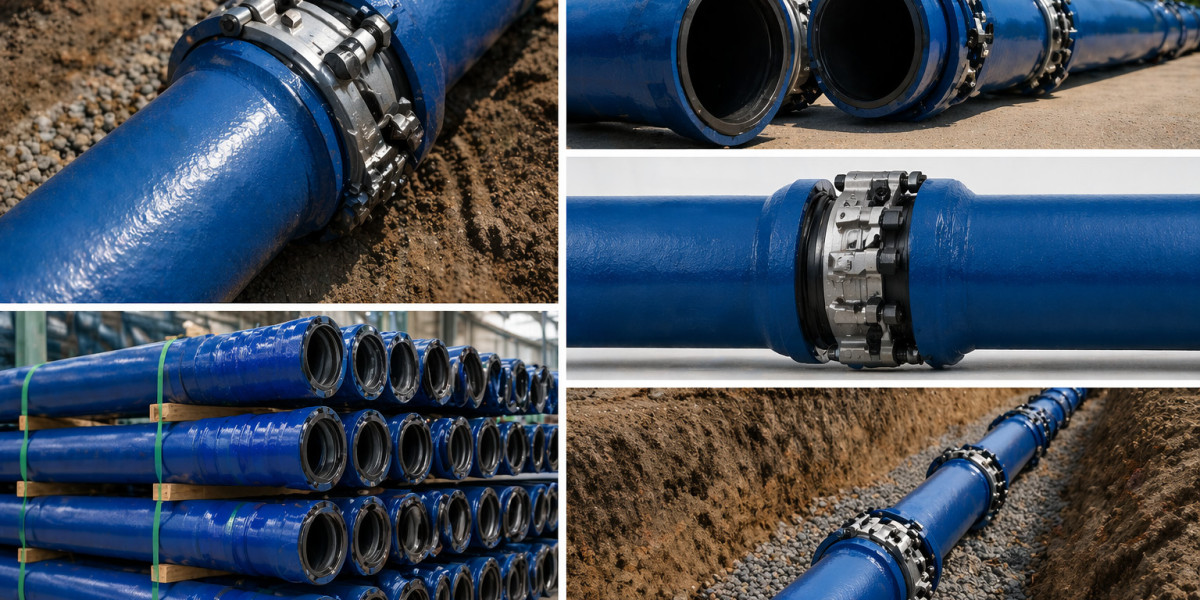
Restrained Joint DI Pipe systems are designed to prevent exactly this. The mechanical restraint locks the joint against axial movement, ensuring that even in a combined positive-negative surge cycle, the connection holds. For transmission mains, high-pressure zones, and pump discharge lines, restrained joints are not optional; they’re the only responsible specification.
The Role of DI Fittings in a Surge-Ready System
A pipeline is only as strong as its most vulnerable component. In surge management, that vulnerability is often in the fittings, bends, tees, reducers, and flanged connections where the direction of flow changes, pressure concentrates, and structural stress is greatest.
DI Pipe Fittings, produced to the same ISO 2531 and EN 545 standards as the pipe itself, ensure that all connection points in the network meet the same pressure rating and surge allowance as the straight runs.
Mismatched fittings, lower-grade materials, different materials, or non-standard dimensions create weak nodes in an otherwise sound system. This is considered a critical specification decision that procurement teams in Indian water supply projects cannot afford to get wrong.
Conclusion
Surge pressure is not an edge case. It is a daily operating reality for every water supply network in India. The pipe material you choose either handles it or eventually fails because of it.
Ductile Iron Pipes, built to the right standards, with the right fittings and joint systems, are the only material in wide use today that treats surge resistance as a design requirement rather than an afterthought.
FAQs
Q1. What causes surge pressure in water supply pipelines, and how often does it occur?
Any change of flow velocity in the pipeline will create a surge pressure. In reality, pump starts and stops, fast valve closures, movement of air pockets through the pipeline, and demand changes at the ends of the distribution network cause these problems.
Q2. How do Restrained Joints in DI Pipe systems help during surge events?
Standard push-on joints can withstand normal operating pressure but can be pulled apart by a negative pressure wave following a surge spike. This is prevented by Restrained Joints, which mechanically lock the joint against axial pull-out.
Q3. Does the grade of DI Pipe fittings affect how well a system handles surge pressure?
The flow changes direction, and the pressure is most concentrated at the fittings. Non-standard or undersized fittings introduce weak points that fail under surge loads, when the surrounding pipe sections are capable of taking the load.